Agile Accounting and Business Planning
This course explores the fundamental principles of the Agile Manifesto and demonstrates how they can streamline your processes, without compromising quality or increasing risk. You will learn how to implement a framework that applies agile methodology to all your accounting practices, including month-end reporting, business planning, forecasting and decision making.
£100 +VAT

Agile Accounting and Business Planning
£100 +VAT
Agile Accounting and Business Planning
This course is not currently available. To find out more, please get in touch.
This course will enable you to
- Understand the principles and characteristics of agile accounting, and the benefits of using them in your role
- Apply agile accounting to finance transactions, including the period-end close
- Define agile performance management and your responsibilities in this area
- Explain the benefits of agile business planning and forecasting compared to traditional approaches
- Use agile decision making in your finance role to support organisational strategy
About the course
Accountants need to be increasingly responsive and flexible to keep up with the rapidly evolving and challenging business environment. They must produce information more quickly, and adapt swiftly, to develop and amend plans, and to continuously revise strategy as circumstances unfold. Agile offers a framework for this new way of reporting, planning, forecasting, managing and decision making.
This course explores the fundamental principles of the Agile Manifesto and demonstrates how they can streamline your processes, without compromising quality or increasing risk. You will learn how to implement a framework that applies agile methodology to all your accounting practices, including month-end reporting, business planning, forecasting and decision making.
Contents
Agile overview
Agile manifesto
What is agile accounting?
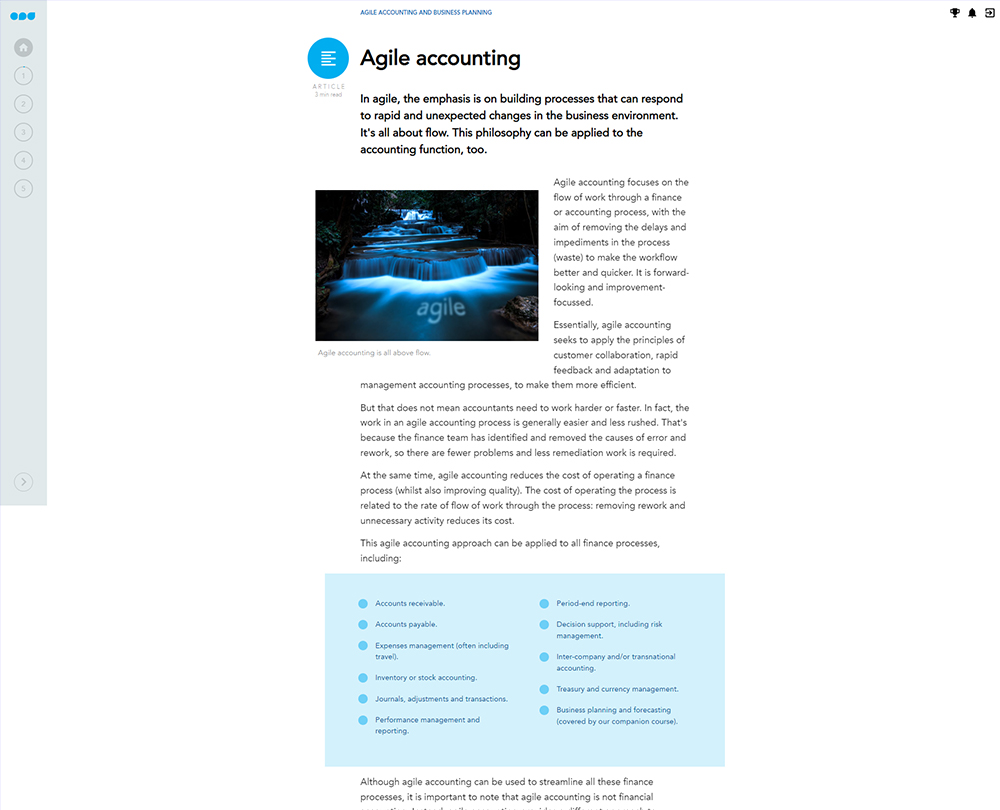
Agile accounting
Key characteristics
Benefits and challenges
Framework
Improvement culture
Getting started
Agile transactions and period-end
Agile receivables and payables
Agile period-end close
Improving the period-end close
Tips for the agile period-end close
Financial controls and risks
Getting started
Agile performance management
Managing performance in agile
The role of the accountant
Key business processes
Agile profit and loss account
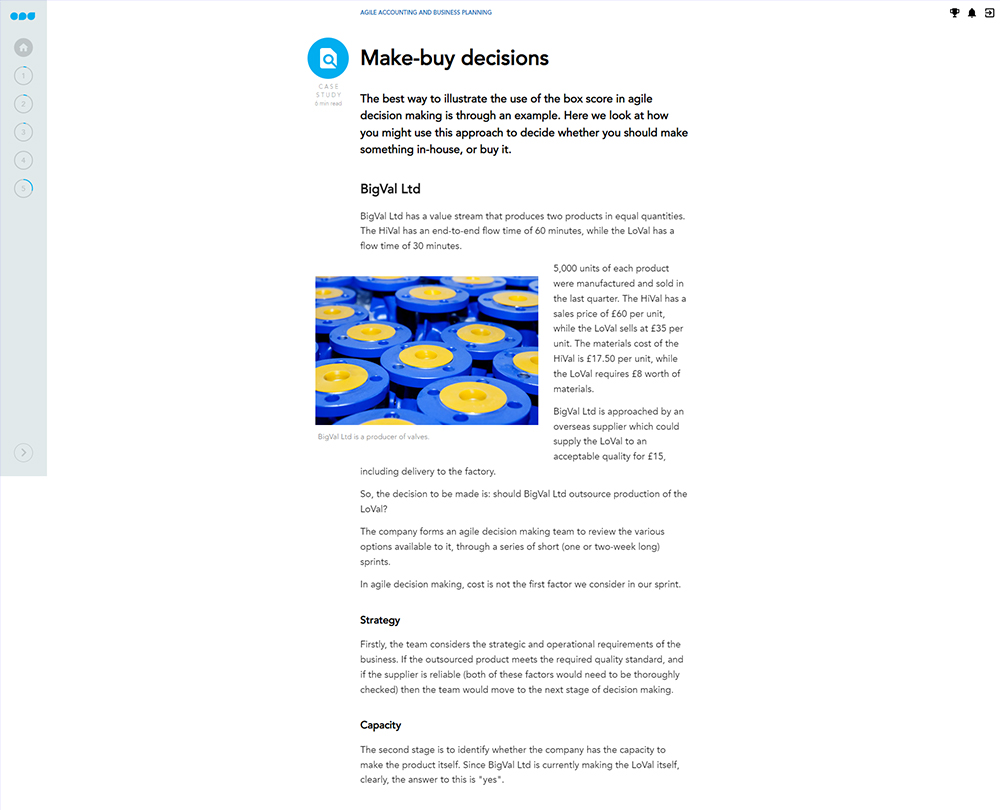
Box score
Elements of the box score
Agile planning and forecasting
Traditional planning and forecasting
What are agile business planning and forecasting?
Agile business planning
The role of management
The role of the accountant
Planning into practice
Agile forecasting
Relative forecasting
Benefits and challenges
Getting started
Agile decision making
Rules of agile decision making
The role of the accountant
Understanding the impact on performance
Final thoughts on agile accounting
How it works
Author

Ross Maynard
Ross has worked as a consultant and trainer for over 20 years, specialising in finance processes, management information and performance measurement. He supports organisations to understand their processes; facilitates improvement teams; and supports staff to work together as a team to deliver tangible and sustainable improvements.
You might also like
Take a look at some of our bestselling courses