Data Analysis for Accountants: Statistics
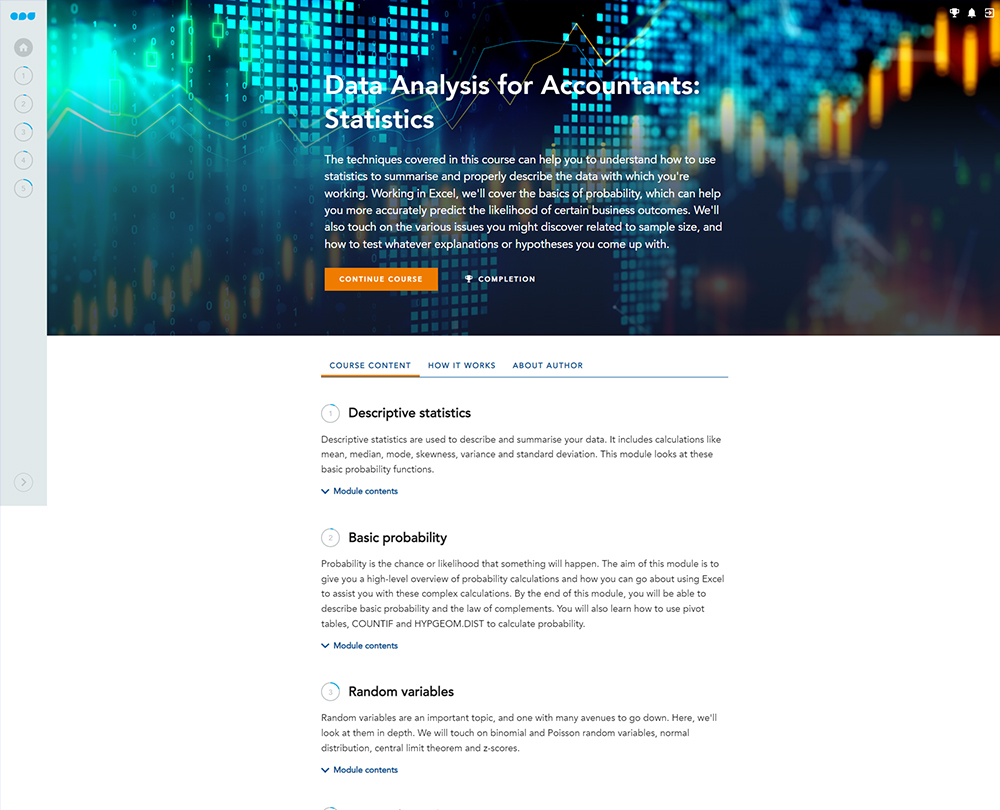
This course explores the various ways you can use statistics and probability to enhance your role as an accounting and finance professional. Gain an understanding of basic probability functions and testing your hypotheses using Excel.
£100 +VAT

Data Analysis for Accountants: Statistics
£100 +VAT
Data Analysis for Accountants: Statistics
This course is not currently available. To find out more, please get in touch.
This course will enable you to
- Understand the basics of probability functions in Excel
- Use statistics to summarise and describe data you’re working with
- Learn how to use pivot tables, COUNTIF and HYPGEOM.DIST to count probability
- Categorise random variables and use binomial distributions and Poisson variables
- Use Excel tools to select samples, calculate confidence and estimate a population size
- Test explanations or hypotheses you come up with using Excel
About the course
As accountants, we are all familiar with Excel. However, in a dynamic and ever-changing world, we need to be smarter about how we use the tools we have at our disposal. Using statistics and probability in Excel can help you to enhance your role as an accounting and finance professional. The techniques covered in this course can help you to understand how to use statistics to summarise and properly describe the data with which you’re working.
You will cover the basics of probability, so that you can understand how to predict more accurately the likelihood of certain business outcomes. You’ll also touch on the various issues you might discover related to sample size and then how to test explanations or hypotheses that you come up with.
Contents
Descriptive statistics
Descriptive statistics in Excel
Histograms
Box plots
Categorical and numerical data
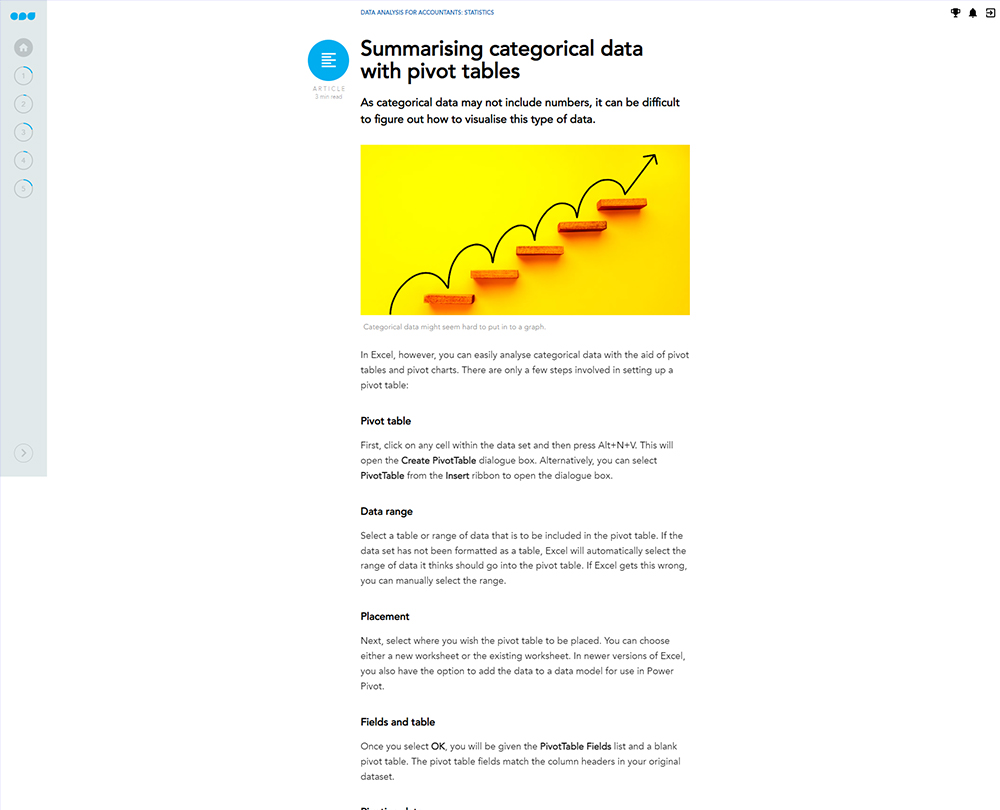
Summarising categorical data with PivotTables
Categorical data and PivotTables
Formulas for descriptive statistics
RANK, LARGE and SMALL
Geometric mean
Basic probability
COUNTIF
The law of complements
Independent and mutually exclusive events
Conditional probability
HYPGEOM.DIST
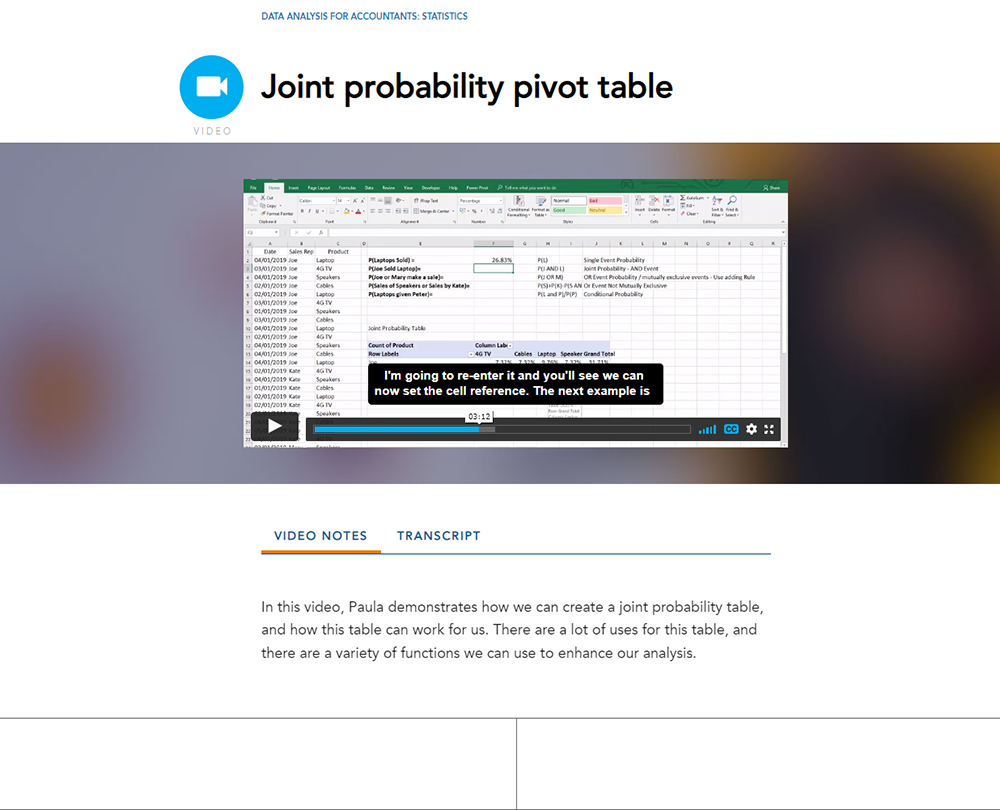
Joint probability PivotTable
Random variables
What are random variables?
Binomial distribution
Poisson variables
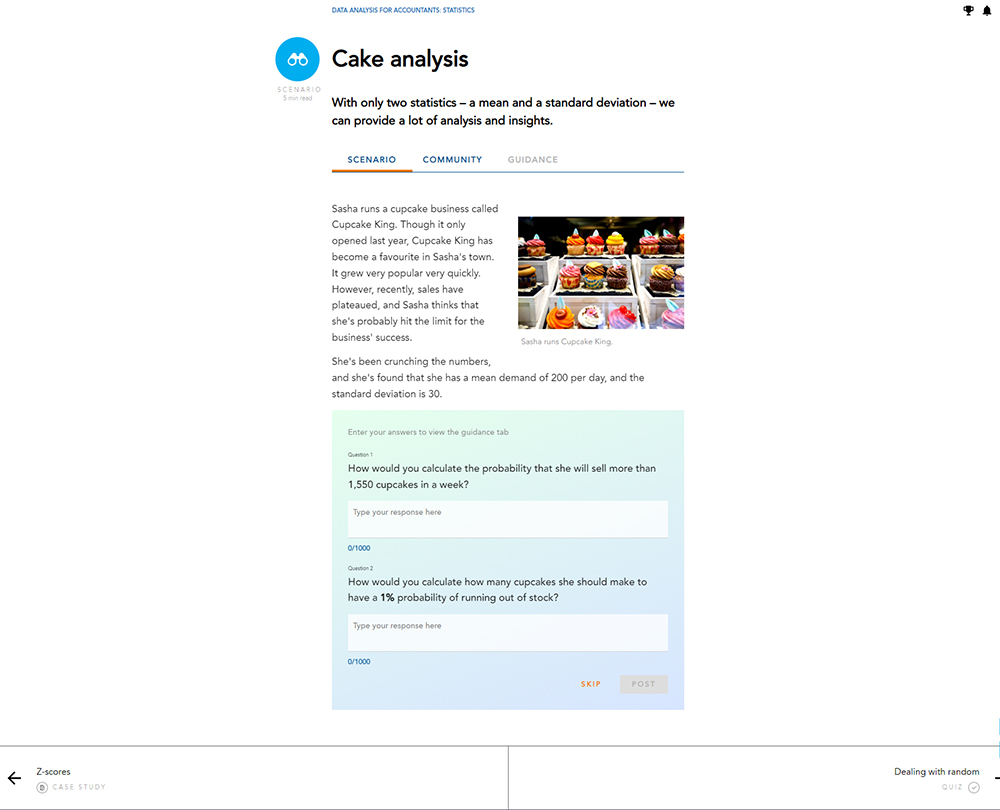
Normal distribution
Basics of sampling
Populations and samples
CONFIDENCE.NORM and CONFIDENCE.T
Population size
Hypothesis testing
Z-tests
What is a t-test?
Correlation
Two sample Z-test
How it works
Author

Paula Guilfoyle
Paula practiced in Industry for over 15 years, working with both small and large private companies, before moving on to teach Excel and Power BI to accountants and professionals.
You might also like
Take a look at some of our bestselling courses