Financial Modelling: Business Simulation
Updated for 2024. Did you know Excel can be used to model potential business situations? In this course, you can learn the basics of business simulation in Excel, along with how to create financial models to aid decision making.
£100 +VAT

Financial Modelling: Business Simulation
£100 +VAT
Financial Modelling: Business Simulation
This course is not currently available. To find out more, please get in touch.
This course will enable you to
- Understand the basics of business simulation in Excel
- Use Excel to create cost-efficient, effective business simulations
- Understand what constitutes good data, and how to properly analyse it
- Learn how to set up queuing simulations, and their importance
- Gain an understanding of financial models and the value they provide
About the course
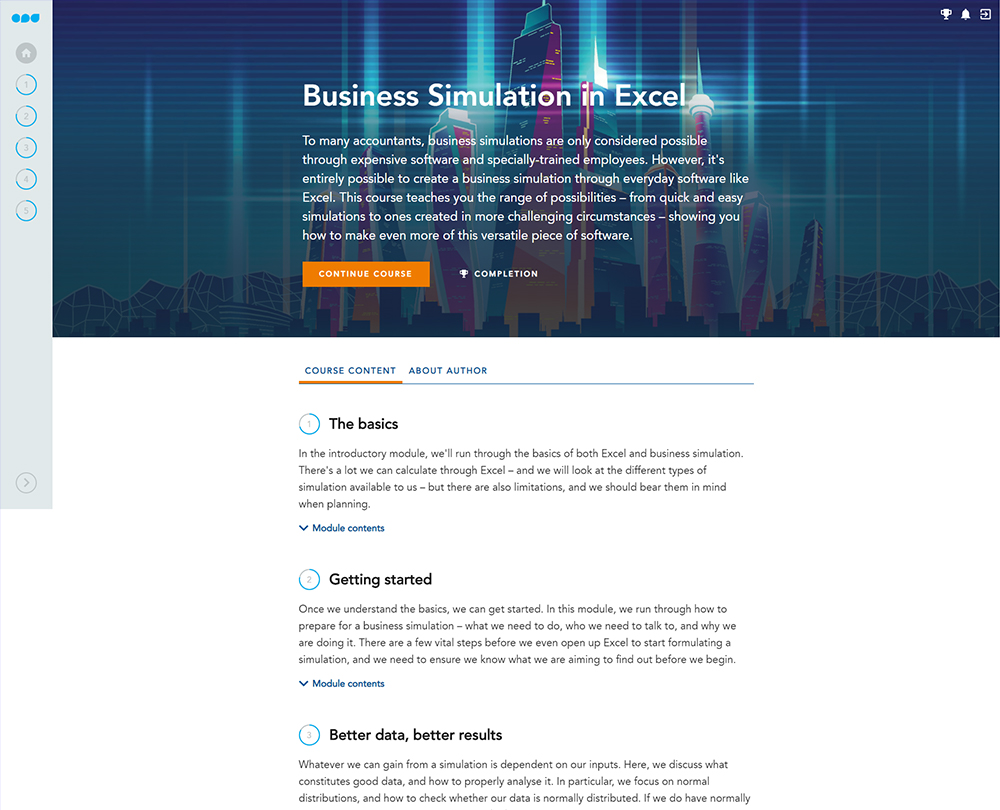
As accountants, we use Microsoft Excel all the time. But have you ever used Excel to simulate potential real-world business situations? Often, we assume more sophisticated and expensive software is required, but Excel can often be the more cost-effective and efficient choice.
This course takes you through the basics of modelling and business simulation in Excel, and guides you through building some of the illuminating options available to you. It also looks at the importance of collecting good data for analysis and explores how to set up queuing simulations and financial models to aid decision making.


Contents
The basics
What is business simulation?
Business simulation with Excel
The principles of business simulation
Types of business simulation
The dangers of simulations in Excel
Getting started
How to begin
Identifying stakeholders
Agreeing on the question
Planning the data
Using data
Understanding Kali’s Korner
Understanding Bobby Bingo
Better data, better results
Using real data
Returning to Kali’s Korner
“Forecast Sheet” function
Normal distribution
Determining whether data is normally distributed
Examining the characteristics of a data sample
How to show if a set of data is normally distributed
Selecting data using a normal distribution
Understanding the Grange Hotel Restaurant
Queuing and waiting
Simulating queues
Challenges in queuing
Generating random events from a Poisson distribution
Using a Poisson distribution
Understanding Trumpton Town Zoo
Understanding the petting zoo
Understanding the digibox
Financial modelling
Simulation in financial models
Modelling input costs
Qualectro and input cost modelling
Modelling customer demand in a simulation
Using a Poisson distribution to model customer demand
Understanding Qualectro
Understanding the SupaScoota
Final thoughts
How it works
Author

Ross Maynard
Ross has worked as a consultant and trainer for over 20 years, specialising in finance processes, management information and performance measurement. He supports organisations to understand their processes; facilitates improvement teams; and supports staff to work together as a team to deliver tangible and sustainable improvements.
You might also like
Take a look at some of our bestselling courses