IFRS 19: Subsidiaries without Public Accountability: Disclosures
IFRS 19 has a narrow scope, yet the implications for the financial statements of the entities that adopt it will be significant. This course examines the details of the changes IFRS 19 implements, and what information is needed – and no longer needed – in the disclosures.
£100 +VAT

IFRS 19: Subsidiaries without Public Accountability: Disclosures
£100 +VAT
IFRS 19: Subsidiaries without Public Accountability: Disclosures
This course is not currently available. To find out more, please get in touch.
This course will enable you to
- Evaluate whether IFRS 19 is appropriate for your organisation by understanding its potential benefits and drawbacks
- Recognise the impact of IFRS 19 on your financial statements
- Identify the information necessary for disclosures prepared under IFRS 19
- Manage disclosures relating to assets and liabilities under IFRS 19
About the course
IFRS 19 Subsidiaries without Public Accountability: Disclosures was one of two new International Financial Reporting Standards introduced in 2024, marking a significant development since the last standard was published in 2017.
This course examines the rationale behind IFRS 19’s inception and its interplay with other high-level standards. It also covers what information is needed – and no longer needed – in the required disclosures, and its potential impact on your organisation should you choose to adopt it. Despite its limited application, IFRS 19 has substantial implications for financial statements.
You will gain a comprehensive understanding of IFRS 19, determine its suitability for your organisation, and develop the confidence to implement its disclosures effectively.

Contents
The context
The year of IFRS
The rationale
Subsidiaries
Benefits and implementation
Objectives and scope
Making it easier
Elections
The effective date
Practical challenges in the timing
High-level standards
The other standards
IFRS 18
IAS 7
IAS 8
Estimation uncertainty
IAS 10
IAS 27
IAS 34
IFRS 13
Non-financial assets and liabilities
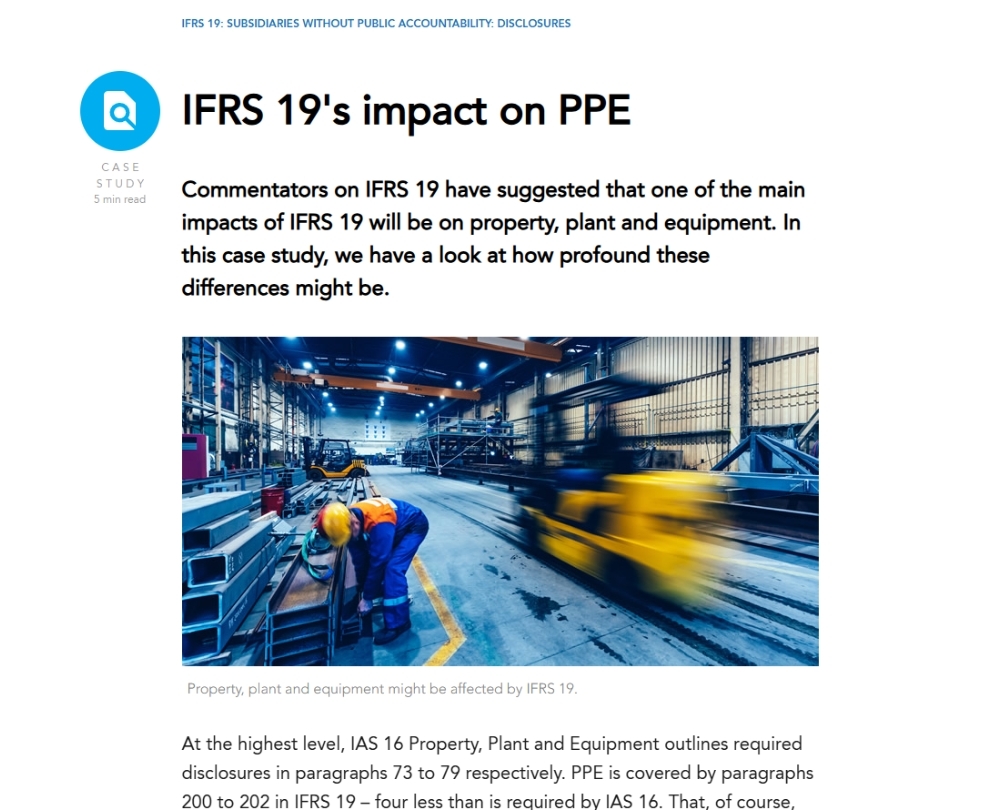
Dealing with PPE
Property, plant and equipment, and other tangible assets
Intangible assets
Impairments
Areas of risk
Provisions, contingent liabilities and contingent assets
Inventory
Other key areas
Revenue
IFRS 15
Financial instruments
Business combinations and interests in other entities
Foreign exchange transactions
Costly business
Costs
Related party transactions
Other standards
How it works
Author

Wayne Bartlett
Wayne is an internationally acclaimed speaker and trainer on all aspects of public and private sector accounting and auditing standards. He has been instrumental in helping to develop the profession internationally and has taken lead roles in the development of new professional bodies and the accounting profession in Mozambique and Rwanda, and been extensively involved in developing financial reporting in many countries across the globe.
You might also like
Take a look at some of our bestselling courses