KPIs for SMEs
Updated for 2024/25. There are many different KPIs that can be used to monitor performance so it’s important to identify the ones that are most relevant to you. This course looks at useful KPIs for SMEs in different areas and how to use them to improve your business.
£100 +VAT

KPIs for SMEs
£100 +VAT
This course will enable you to
- Establish the framework and the tools you need for managing performance in SMEs
- Understand the most important KPIs for customer performance and employee performance
- Develop a set of KPIs for your SME to measure the effectiveness and efficiency of the business
- Be confident about KPIs to measure SME financial performance
- Continuously improve performance by analysing KPIs against your goals
About the course
There are many performance measures available – literally hundreds. We call them key performance indicators (KPIs). But they can’t all be “key” and they are not all equally useful, especially not to small and medium sized businesses. SMEs require KPIs that are easy to measure and easy to understand and that provide valuable information about how to effectively run the business.
Recently updated to include extra content on how to use KPIs as part of a continuous improvement process, this course is about performance measures that work for micro, small and medium-sized enterprises (SMEs). The course provides a straightforward method of performance monitoring that allows problems to be identified and addressed.
This course has been reviewed and revised with content that is up to date for 2024/25
Contents
Getting started
KPI measures in SMEs
The benefits of KPIs
How variation impacts performance
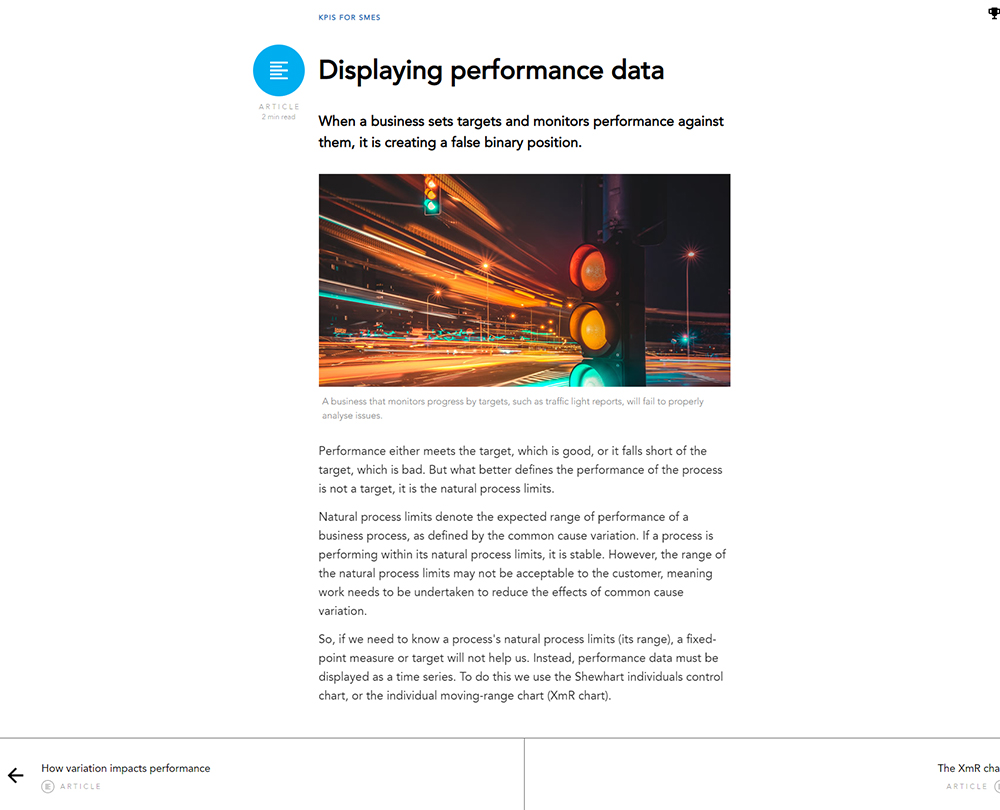
Displaying performance data
The XmR chart
Collecting robust and consistent data
Plotting data in time order
Calculate the natural process limits
Analyse the behaviour of the process
Performance improvements in SMEs
Dealing with variation
People KPIs
The power of customer KPIs
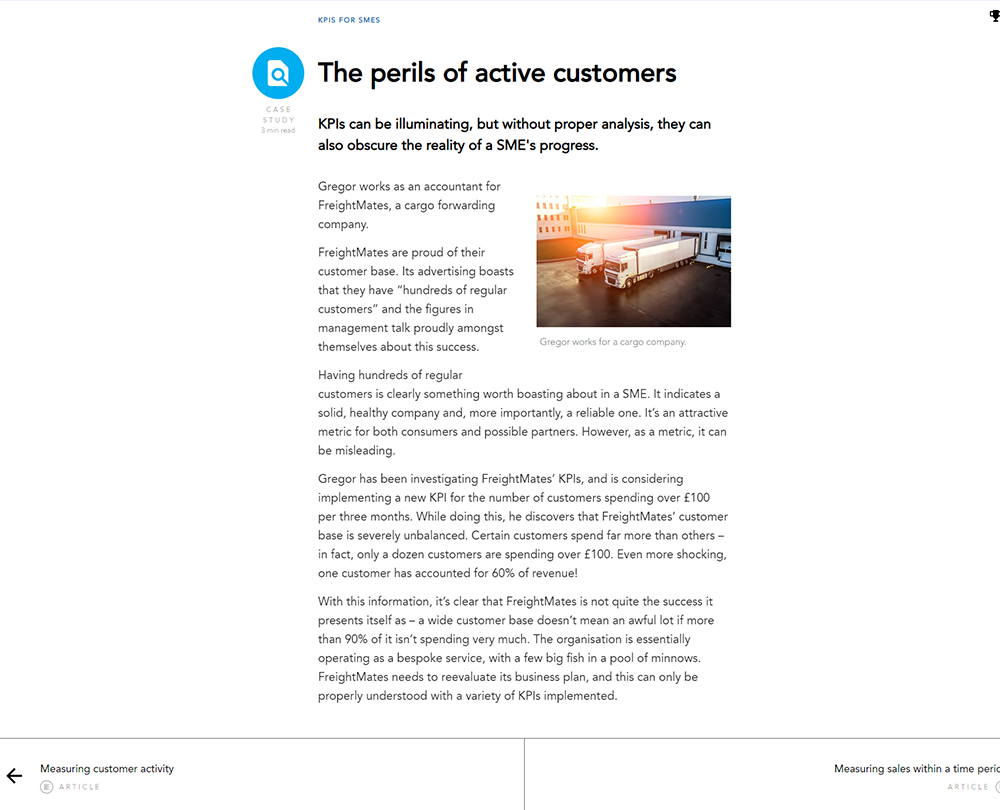
Measuring customer activity
Measuring sales within a time period
Measuring delivery and quotation performance
Measuring customer support and satisfaction
The need for employee KPIs
Employee turnover
Skills matrix performance measures
Measuring employee involvement and satisfaction
The power of employee KPIs
Choosing employee and customer KPIs
Operational and financial KPIs
The power of operational KPIs
Monitoring processes
Inventory turnover
Measuring the quality of products
Measuring suppliers’ delivery performance
The need for financial KPIs
Measuring the contribution margin by value stream
Measuring productivity
The acid test ratio
Measuring debtors and cash flow
Interest cover
Choosing financial and operational KPIs
Monitoring and managing performance
Selecting the final list of KPIs
How many KPIs should SMEs use?
Principles for monitoring and managing performance
Framework for managing performance
Developing practical solutions
Methods for monitoring and analysing performance
Implement your initial KPIs
How important are KPIs?
Putting it into practice
Facilitating improvement in SMEs
Effective meetings
KPI progress meetings
Facilitating meetings
Building trust
The structure of a KPI progress meeting
Encouraging ideas and engagement
Good and bad meetings
Refining and strengthening ideas
Monitoring progress
Giving feedback
Keeping it fresh
How it works
Author

Ross Maynard
Ross has worked as a consultant and trainer for over 20 years, specialising in finance processes, management information and performance measurement. He supports organisations to understand their processes; facilitates improvement teams; and supports staff to work together as a team to deliver tangible and sustainable improvements.
You might also like
Take a look at some of our bestselling courses